
U.S. grocery sales grew 1.2 percent in 2025, but the gains came from price increases of 2.2 percent while volumes declined 1 percent – a market that grew in dollars as shoppers bought fewer units, according to McKinsey & Company’s The State of Grocery North America 2026 report, published in June. The analysis drew on a March survey of nearly 5,000 shoppers and an April poll of over 40 grocery executives across the U.S. and Canada, revealing an industry under significant strain.
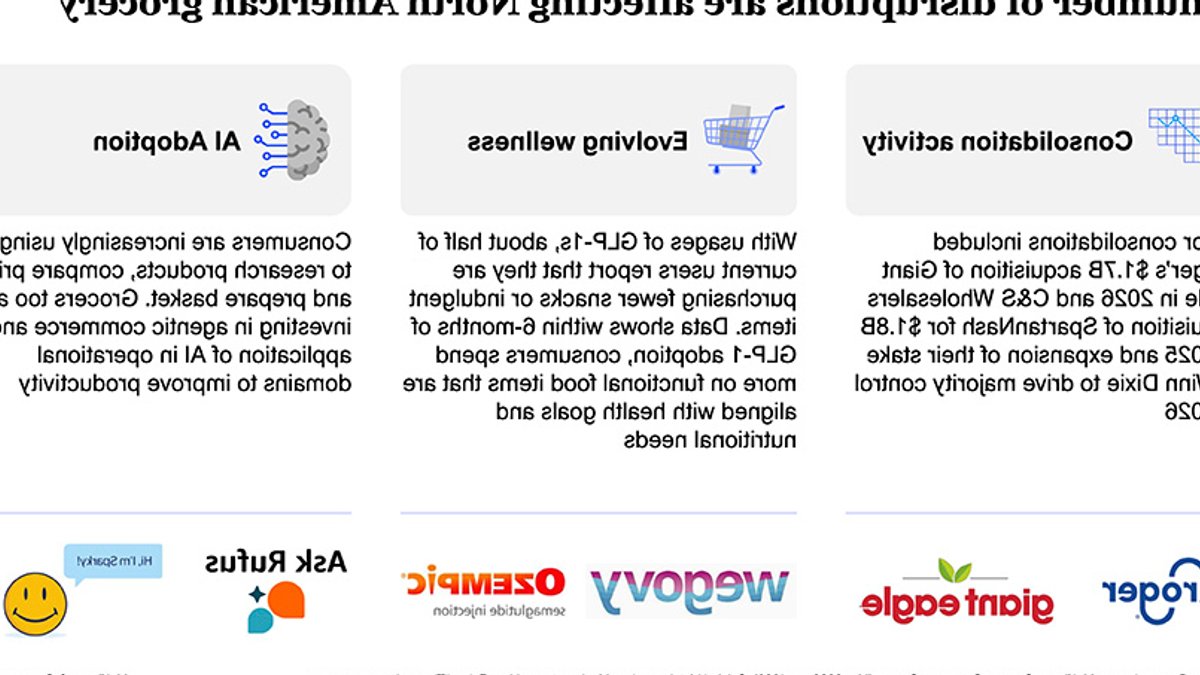
The sector’s total shareholder return of 12.2% in 2025 trailed the S&P 500’s 18.3%, with performance varying sharply by format. Two key disruptions drove these results: industry consolidation and the surge in GLP-1 medications. Kroger’s acquisition of Giant Eagle and C&S Wholesale Grocers’ move to take majority control of Winn-Dixie—following its earlier purchase of SpartanNash—highlighted a period of aggressive restructuring. Meanwhile, weight-loss drug adoption reshaped consumer habits, with 16% of households currently using them and another 7% reporting past use.
Consumers cut trips, grocers fight for visits
The report outlines seven major trends transforming grocery: value pricing, private-label growth, fresh food demand, wellness-focused shopping, e-commerce expansion, retail media, and artificial intelligence. The most pressing issue remains consumer spending. Units per trip declined across all channels except drugstores in the year ending June 2026, and purchase frequency, once rising, has begun to fall. Bill Aull, a McKinsey partner specializing in grocery retail, noted that this trend creates challenges in securing consumer visits. “That raises the challenge in terms of really fighting for the trips of consumers, and we see that as a broad-based trend across channels,” Aull said.
Over half of shoppers now reduce impulse purchases, and 80% of grocers plan to prioritize key value items in their pricing strategy. Personalized promotions are projected to rise from 35% of current offers to 55% within two to three years, driven by loyalty programs. Shoppers who use tailored deals spend 4.3 times more annually than those who do not.
Private-label sales expanded nearly three times faster than national brands in 2025, capturing 20.7% of North American packaged food and beverage sales. Twenty-nine percent of consumers expect to buy more private-label products, and 85% believe these match or exceed national brands in quality. Nearly all grocers (97%) intend to increase investment in private-label innovation over the next two to three years. Aull stated, “Private brands are going to continue to be a true differentiator for grocers as they continue to compete in this era over the next four to five years.”
Fresh food demand clashes with cost hurdles
Fresh and quality rank as the second-most important factors in shoppers’ in-store experience, behind only price. Forty-three percent visit retailers specifically for fresh offerings, and 42% purchase more packaged goods when buying fresh or prepared foods. Yet scaling fresh remains difficult: 88% of grocers cite cost pressures, 78% point to labor shortages, and 69% struggle with supply chain complexity. Alexandra Kuzmanovic, a McKinsey partner, explained, “Fresh is becoming a critical differentiator in grocery, but delivering that with consistency is really where the rubber meets the road when it comes to fresh.”
Prepared foods are broadening competition, with purchase frequency up 9% year over year. About 25% of consumers now replace restaurant orders with grocery-prepared meals. This shift aligns with wellness trends: among households using GLP-1 drugs, 48% buy smaller portion sizes and 46% reduce snacks and indulgent items, while spending increases on fresh produce, yogurt, and high-protein snacks. Nearly 90% of grocers expect to expand shelf space for protein-rich products, and 60% of consumers say the best wellness-supporting retailers integrate pharmacy, food, and wellness solutions.
Delivery now represents nearly two-thirds of online grocery orders, a 28-point gap over pickup, per Coresight Research data cited in the report. Joshua Reuben, an associate partner, noted that the data is self-reported by consumers, which skews slightly higher toward delivery than other analyst reporting suggests. “What we’re seeing is not simply a continuation of a long gradual trend, but delivery has really pulled away in the last few years,” Reuben said.
Time savings is the top reason (67%) for choosing home delivery, followed by free shipping (52%), though only 12% cite discounted delivery as a factor. McKinsey’s projections across 182 metro areas suggest online grocery demand could exceed fulfillment capacity by $23, $28 billion by 2030, as manual store-based fulfillment peaks around 12, 15% penetration.
E-commerce profitability hinges on smart fulfillment
The financial outlook for e-commerce has improved: 46% of grocers report the channel is already profitable, and 72% expect it to surpass in-store profitability within two to three years. However, fulfillment strategy remains a competitive priority. Reuben noted, “Fulfillment strategy itself is going to be a competitive advantage. The winners will be those that add capacity in the right places.”
Retail media, though still a minor revenue stream, 1% for most grocers, contributes 20% or more of enterprise value at companies like Walmart and Target. At Walmart, media generates 12% of EBIT and 26% of enterprise value. Reuben emphasized, “Retail media shouldn’t be treated as a side project. It’s not just an extra revenue stream on the side.” Grocers are expanding into standalone data businesses, with Kroger’s 84.51 and Walmart’s Scintilla leading the effort. Sixty-four percent now view trade, retail media, and joint business planning as “mostly or fully integrated.”
Consumer willingness to use AI declines as autonomy increases, from 51% for assisted product search down to 20% for “fully automatic ordering” with no user review. Tom Kilroy, a senior partner, noted, “I think folks still like grocery shopping. They still like having a say in the process.”
The report’s central message is clear: grocers must integrate these shifts rather than treating them as separate efforts. Kilroy emphasized, “Do not manage these as isolated projects. Building a unified system is the new competitive edge.”


